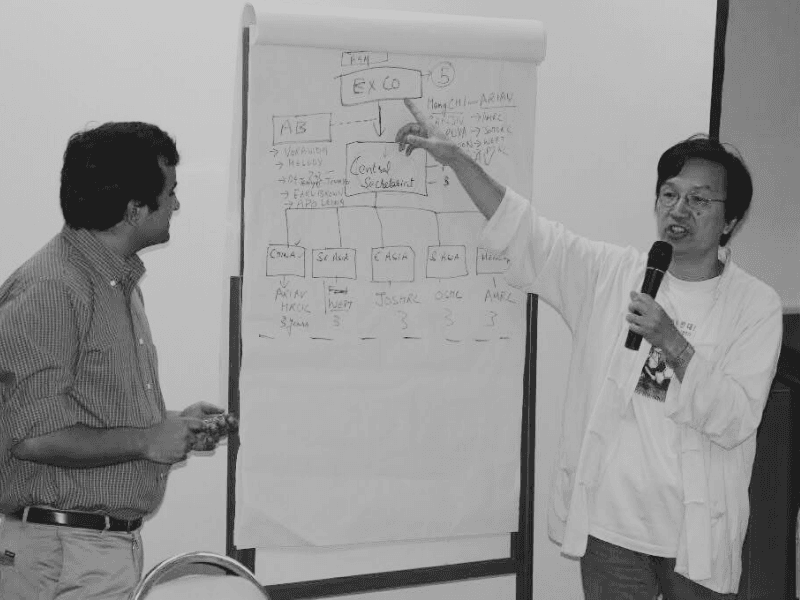
Editor’s Note: On Friday, 14 August 2026, Apo Leong, who had made enormous, decades-long contributions to Asia’s labour movement, passed away in Hong Kong.
Apo, who grew up in Macau and moved to Hong Kong as a teenager, worked tirelessly as a labour reporter, organiser, campaigner and leader. He was a mentor and friend to a generation of labour activists in Hong Kong and across Asia.
For many years, Apo worked at the Hong Kong Christian Industrial Committee (HKCIC) with a focus on victims of industrial accidents, and led the Asia Monitor Resource Center (AMRC) as its first Asian Director until his retirement in 2008.
In his many roles over the decades, he built networks in Asia, developed collaborations with labour groups, and engaged deeply in initiatives strengthening grassroots movements on workplace health and safety. In his retirement, Apo continued to support the movement.
We spoke with Sanjiv Pandita, who had worked with Apo at AMRC since 2001 and succeeded Apo as AMRC’s executive director between 2008 and 2016. They collaborated closely on building the Asian Network for the Rights of Occupational and Environmental Victims (ANROEV) which unites workers across more than 16 countries to demand safe workplaces.
In this interview, Sanjiv shared his memories of Apo Leong as an dedicated activist, a mentor, a leader, and, in Apo’s own words, a street fighter.
Asian Labour Review (ALR): Thanks for doing this interview. We know you have known Apo Leong as a friend, colleague, and mentor for close to three decades, and worked closely with him. What are your first memories of Apo Leong?
Sanjiv Pandita (“Sanjiv”): The first time I met Apo was in Macau in 1999. I used to be based in Delhi, working on occupational health and safety. In 1999, I joined a conference in Macau. I met this really simple person. He was jovial and very welcoming, and that’s something that has stayed with me. Yet he was very forceful in how he structured his argument.
After the conference, we were having hotpot, and Apo was preparing the food for everyone. I said, “Hang on, I am not sure if this meat is cooked. He was laughing.” That was my first memory. Then we went out, and I saw a red Ferrari car. Apo said, “Oh, do you want to take a photo with that? I said, “Yes, why not? And Apo took out a camera and clicked a picture of me.
Then there was a job opening for a documentation officer at Asia Monitor Resource Center (AMRC), and I applied for it. I had an interview in Hong Kong and joined the organisation.
At that time, AMRC was located in a small flat, and every Thursday, we would have lunch in the office. After lunch, Apo got up and started cleaning the dishes. I thought, “Hang on, he’s the executive director of an organisation, and he’s cleaning the dishes?” That was not something I had seen in India. Apo came across as a very humble and down-to-earth person.
We would later observe another side of Apo. Apo would usually be very calm in meetings. But once he started talking about structural inequality and how we needed to fight it as a movement, you would see his passion. He looked like a very different person. That was his passion.
ALR: You worked with Apo for many years at AMRC. What was your day-to-day work with Apo like?
Sanjiv: On my first day in the office at AMRC, we went to a protest in the evening. Apo asked, “What are you doing? Let’s go! Let’s go! Let’s go! He did not tell us what was happening. This was Apo’s style. You had to guess. Then, suddenly, we were outside a hotel because there was union-busting happening there.
He would explain by doing things rather than telling you: this is what the Hong Kong movement looks like, and these are the people in the movement. He would take you to an action and introduce you to people in the movement. Apo would throw you into the water, and you would learn how to swim.
One of the characteristics of the AMRC, and much credit goes to Apo, is that it was very bottom-up and democratic. There was no hierarchy. The entire decision-making process was conducted through staff meetings. This was a highly collaborative process. He was not a director; he was a leader, but not a manager.
I remember in staff meetings, people could even shout at him. We could disagree and shout, and in the end, Apo was still my friend. There was no fear of Apo. We considered him to be our brother. He would look to what was good for a movement. He was not a good project manager. I believe these are the differences. When discussing organisations, people often refer to projects. I do not think Apo has ever talked about any projects.
ALR: One of our memories of Apo is travelling with Apo in Asia. He would ask me to join him for book shopping. We did this all over Asia.
Sanjiv: Apo knew bookshops everywhere on earth. You may go with him to London, Jakarta, New Delhi, Bangkok, or Taipei. He knew where the bookstores were, especially where the workers’ books were, and he would make a point to buy books. He instilled in the movement an understanding of how important it is to read. And he would give books to all of us.
He was one of the most well-read people I have ever known. He would voraciously consume books. I do not think I have seen anyone read so much. AMRC had one of the best libraries of working people in the region. He single-handedly picked and built the library book by book.
My initial role at AMRC was to collect information on different labour rights things and then share it with the region. Apo would quietly come in the morning with newspaper clippings he collected and put them on my desk even before I was in the office. He had already prepared, and he would just share whatever information he thought useful.
His readings were an essential part of understanding the working class movement at a time when Asia was undergoing industrialisation. He was not only reading; he was also meeting those people. He knew what the movements were. But he wouldn’t write. His point was that we need to start doing.
ALR: To put Apo’s work in context, the late 1990s and early 2000s were a period when a lot of industrial production moved from the industrialised economies elsewhere to Asia, as well as within Asia, from Korea, Japan, Taiwan and Hong Kong to China and Southeast and South Asia. There was a lot of interest in building new movements and transnational labour solidarity.
Sanjiv: Apo was heading an organisation established by two Catholic missionaries from the United States to monitor American investments in the Philippines. It then became an Asia information centre.
For a long time before Apo joined, all of its directors came from outside Asia. Apo was the first Asian director. Under Apo, AMRC would fight to get work visas for people across Asia to work at AMRC. We did not have an immigration lawyer. Apo would personally go to the immigration office and fill out all these visa applications.
This gave AMRC a completely different outlook. Apo wanted people from Asia’s labour movements to work for AMRC. He was truly an internationalist. His whole idea of building an Asian labour movement would always be in his genes.
An important contribution Apo made was his engagement with the Chinese labour movement. At a time when China was industrialising, and there were spaces available, Apo would communicate with people in touch with workers to understand what was happening to migrant workers. What are their issues? What are the ways, within constraints, we could offer some kind of transformative change? How can we link them with the rest of the Asian movement?
Trade unions in the Global North were eager to visit China, and Apo was open to it. But he focused his energy on how you can build something meaningful on the ground that is sustainable, so that workers can benefit.
ALR: You mentioned Apo as someone very friendly and approachable, but can also be very passionate about things he cared deeply about? What are the things that he can get angry about?
Sanjiv: Apo was a true champion of grassroots movements. What annoyed him was purely academic discussions about the workers’ movement. That would bore him to death. He was more interested in how grassroots movements can exercise agency in building their own movements and their own narratives.
He would say, “I’m a street fighter”. He would say, “organise, organise, organise”. That’s the key thing. This does not mean that he would not collaborate with academics. I think Apo was very effective at collaborating with academics, but the whole point of such collaboration was to empower the grassroots movement.
ALR: What did Apo mean personally to you?
Sanjiv: Apo was my mentor who helped me develop my thoughts. He helped me to concretise how even occupational safety and health is such a class issue which the labour movement has neglected, and why it is important to build a bottom-up labour movement.
Apo also ensured that I understood every aspect of the local and global labour movements. He was there for us. We would always feel that even if nothing was happening, we could reach out to Apo. You would feel the importance of his presence.
ALR: What do you think is Apo’s legacy for the labour movement in Asia?
Sanjiv: It is difficult to imagine the victims’ rights movement in Asia today without Apo. In 1993, Apo witnessed the cost of “cheap labour” when hundreds of young workers, mostly women, died or were severely injured in the Zhili toy factory fire in China. It was one of the worst industrial disasters of its time.
Apo led the fight for justice for victims of these factory fires. He worked tirelessly with organisers on the ground, helping build solidarity within the Asian labour movement and globally to hold employers and multinational brands accountable.
This struggle brought victims’ movements across Asia together, culminating in the establishment of the Asian Network for the Rights of Occupational and Environmental Victims (ANROEV) in 1997. Over time, ANROEV grew into the largest grassroots network of its kind. Apo’s vision and leadership built this indigenous Asian network.
ALR: How can we carry on Apo’s legacy?
Sanjiv: There is a bit of Apo that lives in all of us who have been touched by him. His legacy was simple: we must build the agency of the workers on the ground; they are not just silent recipients but active participants in change.
Apo built AMRC as a truly Global South institution that would mirror the Asian labour struggle. In a world transforming at an unimaginable scale, this means finding new ways of organising and bargaining to build worker power. Apo would often joke that what you think is new has been tried before, only forgotten.
Carrying forward his legacy is an active responsibility as we confront the climate crisis, platform and tech feudalism and capitalism, and repressive democratic spaces in Asia.
Return to the grassroots with Apo’s mantra: organise, organise, organise, and recover the forgotten lessons of past struggles. Importantly, do not lose faith in the power of organised workers and communities to remake the world.