Since its establishment in 1976, the Asia Monitor Resource Centre (AMRC) has served as a regional hub for labour solidarity in Asia. This article reflects on the AMRC’s half-century journey towards building inter-Asian labour solidarity. It discusses not only what AMRC has achieved, but also what it has failed to achieve, why it has failed, and what these experiences might tell us about the future of inter-Asian labour solidarity. This is a personal reflection, drawing on my 23 years of involvement with the AMRC in various capacities: as a full-time activist, a member of the Board of Directors, a member of the Regional Council, and Chair of the Board of Directors.
International labour solidarity has long occupied a prominent place in the political imagination of labour movements. Almost every major trade union has declared its commitment to internationalism. However, there is a considerable distance between internationalism as a declared principle and internationalism as an actual process of movement building. Affiliation to international trade unions, participation in international conferences, and occasional solidarity campaigns do not necessarily generate lasting solidarity among workers across national borders.
This distinction between international solidarity as a dead principle and as a living practice was central to an experiment in building bottom-up inter-Asian labour solidarity in which I participated during the 2000s as an AMRC activist coordinating the Asian Transnational Corporation Monitoring Network (ATNC Network). As one of the regional labour networks AMRC initiated, the ATNC network sought to connect grassroots workers’ organisations across Asia. Its broader ambition was to build an alternative foundation for international labour solidarity in Asia.
Building a Network from Below
When I joined AMRC in 2003, the ATNC Network already existed as a pilot initiative, with a substantial emphasis on corporate codes of conduct. Such an approach was becoming increasingly popular in international labour advocacy, particularly following the emergence of consumer campaigns targeting major international brands during the late 1990s and early 2000s.1
We were sceptical of the political consequences of this prevailing model of north–south labour solidarity. Our scepticism concerned the underlying structure of solidarity that this approach reproduced. Northern organisations possessed the resources, connections, and influence required to pressure major brands, while workers and their organisations in Asian production sites were primarily positioned as recipients of assistance. The political focus often shifted from workers’ collective struggles to consumer organisations’strategies and their relationships with corporations.
Such campaigns sometimes achieved meaningful results. They can generate international attention, provide protection to workers, and force employers to negotiate. We did not deny their practical value. However, they had little to do with building the larger collective power of workers. For us, workers’ power was something to be built collectively by workers in and beyond workplaces rather than granted by individual employers’ moral behaviour.
Therefore, we sought to reverse the direction of the network’s activities. Instead of beginning with corporations and their codes of conduct, we wanted to begin with workers’ struggles, their own organisations emerging from such struggles, and solidarity-based relationships built between such organisations.
These relationships developed through practical engagement. A group of workers or worker organisations might initiate a strike or an organising campaign. AMRC and its local partners could support the struggles on the ground. Over time, this process allowed us to include more organisations, whether unions or NGOs. Through such activities, new relationships emerged between organisations participating in the same struggles.
Our criteria for partnership were therefore not primarily based on size, institutional recognition, or formal representativeness. We were interested in organisations with real connections to workers’ struggles. This frequently meant working with small but independent unions and grassroots NGOs rather than established national trade union centres.
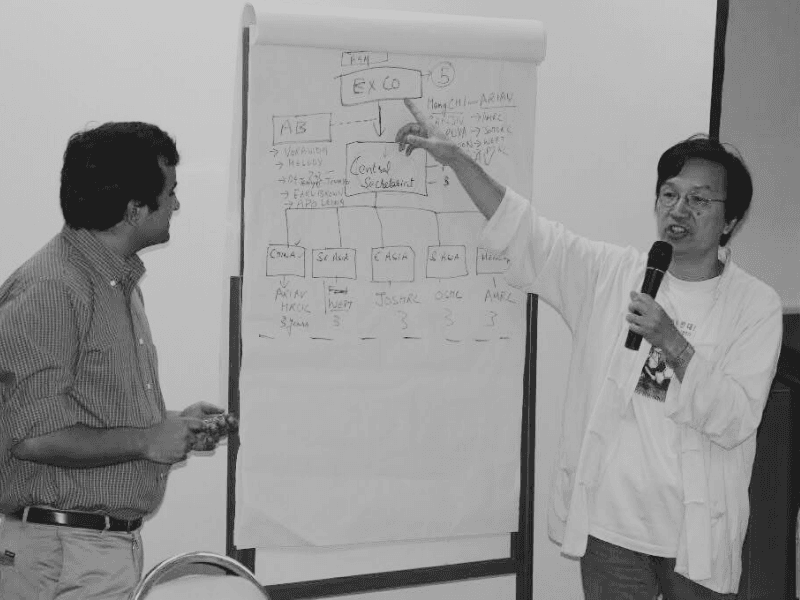
While building a network of such organisations, the network operated through collaborative research, education, organising, and advocacy. Activities involved collectively identifying regional agendas, coordinating national actions, and bringing activists together. To do so, we organised regular meetings of younger labour activists and organisers. During the particularly active years between 2003 and 2006, meetings took place in Indonesia, Thailand, Hong Kong, and elsewhere.
An important principle was offering activists from different nationalities and backgrounds opportunities to work together as a team. Therefore, rather than bringing together entirely different participants at each meeting, we sought to develop a relatively consistent network of activists who would encounter one another repeatedly. These encounters allowed participants to move beyond formal exchanges and establish personal relationships. They became familiar with one another’s struggles, organisations, and political contexts. Eventually, some could maintain direct communication without being mediated by AMRC.
This was a significant achievement. International solidarity began to acquire a concrete foundation, beyond meetings and correspondence. It became embedded in the relationships among activists, who increasingly regarded one another as comrades engaged in connected struggles.
The Limits of Institutional Trade Union Internationalism
Our emphasis on bottom-up solidarity emerged from our concerns about established international trade union institutions as well. The problem was not simply their bureaucratic or insufficiently radical characteristics. More fundamentally, they were problematic because their historical formation did not involve Asian labour movements.
These institutions originated from the historical development of labour movements in Europe. National trade unions, once built through local struggles, established relationships with one another and gradually constructed international structures. Whatever the political limitations of these institutions, their emergence was connected to actual processes of labour movement building in Europe.
Their expansion into Asia followed a different trajectory. Rather than emerging through the collective efforts of Asian labour movements to construct their own solidarity instruments, Asian trade unions were incorporated into pre-existing international structures already established elsewhere. Asian trade unions did not collectively build these institutions from the ground up. To put it simply, we are not affiliated with the ITUC because we built the ITUC. In this sense, trade union internationalism in Asia was introduced from above. It was not made in Asia.
This distinction matters because such affiliation does not generate true solidarity. A national union might belong to an international organisation representing millions of workers, yet its members could remain largely disconnected from one another. International solidarity might be expressed through resolutions, petitions, or occasional campaigns; however, it does not become an integral component of workers’ everyday struggles.
Our experiences with international unions were not uniformly negative, particularly when committed individuals within these organisations were willing to support grassroots initiatives. Therefore, the question was not whether they were good or bad. The question was whether they could provide the basis for a genuinely bottom-up labour internationalism in Asia. Our assessment was that they were unlikely to do so.
Consequently, we sought to experiment outside established frameworks. Our ambition was to construct relationships among Asian workers’ organisations through their own collective activities, allowing international institutions to emerge from these relationships rather than imposing institutional arrangements upon them. Therefore, our bottom-up solidarity building had to be inter-Asia solidarity building rather than solidarity building between the global North and South.
The Strategy of Triangular Solidarity
From this principle of building inter-Asia solidarity bottom-up from workers’ collective experience, the ATNC network introduced a new mode of engagement with international labour campaigns, that was the strategy of triangular solidarity. The triangle involved workers’ organisations in capital-exporting countries, workers’ organisations in capital-receiving countries, and solidarity organisations in the Global North.
This was particularly relevant in Asia, where production increasingly involved the movement of capital between countries within the region itself. Japanese, Korean, Taiwanese, and other Asian firms invested in production facilities across Southeast Asia and China, connecting workers in different Asian countries through production networks.2
This offers a material ground for inter-Asian solidarity. Consider the relationship between workers employed by Korean firms in Cambodia and workers’ organisations in South Korea.
If Cambodian workers confronted a Korean employer, why should their principal international connection necessarily be with a consumer organisation in Europe or North America? Why should they not establish direct relationships with Korean workers and labour organisations capable of confronting the same capital from another location in Asia?
The purpose was not to exclude Northern organisations but to reorganise the relationships among these actors. Direct solidarity between worker organisations within Asia should constitute the primary relationship, while Northern organisations would provide supplementary support.
The distinction was political rather than merely geographical. The aim was to shift the centre of international labour solidarity. Without this shift, international solidarity risked remaining a series of interventions in particular disputes rather than a cumulative process of movement building. Therefore, triangular solidarity was a campaign strategy geared toward building movements in Asia.
Our approaches to bottom-up building of inter-Asia solidarity also formed part of a broader political imagination. We were inspired by the historical traditions of solidarity among movements in Asia, Africa, and Latin America, particularly the radical internationalism associated with tricontinentalism.3 We distinguished this movement-oriented internationalism from the state-centred forms of Third Worldism that had developed around national interests.
We imagined that a bottom-up Asian network might eventually establish relationships with comparable movements in Africa and Latin America, contributing to a renewed form of tricontinental solidarity – a genuine triangular solidarity of oppressed workers of the world. In retrospect, we were truly ambitious, believing that we could renew labour internationalism through the collective struggles of workers. However, ambition alone could not achieve what we aimed for. We had important limitations.
Nationalist Internationalism and Its Contradictions
The first limitation was that developing a network of activists committed to inter-Asia solidarity fell short of transforming the orientation of their organisations and movements. This was particularly true for larger unions.
The participation of the trade union representatives was often inconsistent. National unions frequently nominated different representatives according to the specific themes of meetings. Such arrangements enabled individual trade unionists to gain exposure to international labour activism. However, such exposure did not necessarily translate into institutional memory and commitments to inter-Asia solidarity. The network was more successful in cultivating individual internationalists than in constructing internationalist organisations.
This limitation was exacerbated by the nationalist orientation of labour movements in Asia. This is our second limitation. Modern labour movements in Asia developed within historical processes profoundly shaped by colonialism, anti-colonial struggles, and subsequent nation-building, in which strong nationalism underpinned political mobilisation and collective identity. Labour movements frequently understood their struggles as part of broader projects of national independence, democratisation, or development. Their political strategies were therefore strongly embedded in nation-state building.
This history shaped their orientations. Unions sought to organise workers within national territories, influence national governments, and secure labour rights and social protections through national institutions. Such orientations were understandable. Yet, they also contained internationalism, which I would describe as nationalist internationalism.
Cross-border solidarity is valued primarily because it contributes to the strengthening of national movements. International solidarity consequently becomes instrumental. It is mobilised to address a particular national problem, and its political significance diminishes once the immediate problem has been resolved. National trade union centres rarely regard the construction of workers’ power at the international scale as an equally important objective. The resources and support received are absorbed into national movement building rather than accumulated as international organisational capacities.
The Hong Kong mobilisation against the WTO ministerial meeting in 2005, in which AMRC and I were heavily involved, provided an instructive illustration of this problem. The host of the mobilisation, Hong Kong, occupied a distinctive position in regional labour internationalism. Its extensive international connections and peculiar political circumstances enabled it to function as an important platform for Asian solidarity. Unlike others, its internationalist activities were less subordinated to a conventional nation-building agenda simply because Hong Kong was not a nation-state.
During the protests, Hong Kong organisations provided extensive solidarity support to activists from outside, particularly to a large Korean delegation, which formed a significant part of the mobilisation. However, mobilisation was interpreted differently by those who participated in it.
Those more directly involved in mobilisation processes, including Korean activists who experienced arrest and legal proceedings, were more likely to recognise the decisive role played by international solidarity in making the mobilisation possible. However, many Korean activists regarded the protests primarily as a demonstration of the strength of the Korean movement, like K-pop.
The experience demonstrated that international solidarity could acquire concrete political power. However, it also showed how easily such experiences could be reinterpreted through national movement narratives. Individual activists might develop a deeper understanding of internationalism, but this did not necessarily become an organisational lesson or capacity.
The Unequal Material Foundations of Solidarity
Another limitation of the ATNC experiment was the absence of an autonomous material foundation for inter-Asian solidarity. Our network suffered from an obvious contradiction: an initiative committed to developing autonomous solidarity among Asian organisations was itself reliant on financial resources from outside the region.
This problem had immediate practical consequences. Northern advocacy organisations often had the resources and institutional connections necessary to intervene quickly in disputes. Our network, by contrast, possessed political commitment and developing relationships among activists but lacked comparable practical leverage.
Even ATNC partners turned to Northern organisations capable of delivering immediate assistance when workers confronted urgent problems. This reveals a fundamental tension between short-term problem-solving and long-term movement building. Immediate interventions could provide important relief to workers but often reinforced dependence. Building autonomous solidarity requires resources and institutional capacities that can only develop over time.
Reimagining Labour Internationalism in a New Conjuncture
It is time to discuss the future of our experience. Our future strategy and our reflection of past experiences cannot be understood solely in terms of organisational strength or weaknesses. They must also be situated within the historical conjunctures in which AMRC operated and will operate.
The late 1990s and early 2000s constituted a particular phase of neoliberal globalisation. Although neoliberalism intensified the exploitation and fragmentation of labour, it also generated significant political resistance through anti-globalisation movements.
They helped establish labour rights, corporate responsibility, and social development as legitimate concerns within international political discourse. I would characterise this conjuncture as a period of ethical neoliberalism, a global version of what Nancy Fraser calls ‘progressive neoliberalism’ of the US.4 Neoliberal globalisation remained fundamentally organised around the interests of capital, but it operated within a political environment in which ethical claims possessed considerable legitimacy.
This environment created opportunities for labour advocacy. It could appeal to internationally recognised labour standards, corporate accountability, and the moral authority of labour rights as human rights. We sought to exploit these openings while pursuing a more radical objective. In retrospect, we attempted to create something radical out of a liberal moment.
From these attempts during a liberal moment, we learnt several principles. International solidarity must be rooted in workers’ actual struggles. It must develop lasting relationships and collective capacities. It must establish autonomous material resources. Above all, international labour solidarity must become an integral part of movement building rather than an instrument mobilised primarily for national purposes.
The problem was that the liberal moment proved temporary, while the radical organisational capacities we sought to build upon those principles remained insufficiently developed. We lacked the organisational strength and autonomous material foundation necessary to sustain our experiment, as I have discussed.
Following the global financial crisis, the political conditions that once sustained labour advocacy changed considerably. The neoliberal economy has been increasingly combined with political autocracy rather than democracy, creating what might be called ‘liberal autocracy’ across Asia and beyond. This transformation has directly affected many labour organisations across Asia, including AMRC itself. Faced with the increasingly autocratic political environment, AMRC had to cease its operation in Hong Kong, its home for more than 45 years, and establish AMRC 2.0 in South Korea in 2022.
At the same time, the rise of far-right movements in Europe and North America has undermined the political and financial support previously available for international labour solidarity. The discourse of labour rights no longer possesses the same political leverage. The entire institutional environment in which our experiment developed is disappearing.
Yet, these transformations do not necessarily foreclose new possibilities. Across different societies, collective resistance is emerging like wildflowers, frequently involving younger generations whose political experiences are not necessarily mediated by established trade unions or political parties. Young people in Europe are currently turning old European politics upside down. In Asia, we are witnessing an even more remarkable series of youth uprisings in Sri Lanka, Bangladesh, India, Nepal, and Indonesia.
The political direction of these mobilisations remains uncertain. They can be articulated through authoritarian, exclusionary, and xenophobic politics, as we observe in the emerging ultra-right youth movement in Korea.5 Therefore, it would be mistaken to regard the emergence of new protests as evidence of an inevitable revival of progressive labour movements, let alone international solidarity. They may lead to inter-imperial rivalries, dragging Asian communities into conflicts against one another.
Nevertheless, these developments open up a new context that informs a new strategy. Maintaining old practices and institutions will very likely prove increasingly inadequate to the peculiar conjuncture of contemporary capitalism. National trade union structures, international institutions, and the moral discourse of labour rights all need to be evaluated, debated, renewed, and subjected to creative destruction if necessary.
This means that AMRC has a job to do. This is perhaps an even more significant job than before. The central question remains whether Asian workers and their organisations can build international solidarity as a collective political project of their own. This question was at the heart of our experiment more than 20 years ago. This remains unresolved and perhaps demands a more urgent answer today.
Notes
The previous version of this article was presented as a keynote speech at AMRC’s 50-year Anniversary – “50 Years of Labour Advocacy in Asia: From Past Struggles to Future Solidarity”, 4-5 November 2026, Seoul. South Korea.
- For a critique of consumer-oriented campaigns, see Dae-oup Chang and Monina Wong, “After the Consumer Movement: Toward a New International Labour Activism in the Global Garment Industry,” Labour, Capital & Society 38, no. 1 (2005): 126–55. ↩︎
- Dae-oup Chang and Ed Shepherd, eds., Asian Transnational Corporation Outlook 2004: Asian TNCs, Workers and the Movement of Capital (Hong Kong: AMRC, 2005), https://amrcentre.org/asian-transnational-corporation-outlook-2004-asian-tncs-workers-and-the-movement-of-capital/; Dae-oup Chang, ed., Labour in Globalising Asian Coporations: A Portrait of Struggle (Hong Kong: AMRC, 2006), https://amrcentre.org/labour-in-globalising-asian-corporations-a-portrait-of-struggle/. ↩︎
- R. J. C. Young, Postcolonialism: An Historical Introduction (Oxford: Blackwell, 2001), 57. ↩︎
- Nancy Fraser, “From Progressive Neoliberalism to Trump—and Beyond,” American Affairs 1, no. 4 (2017). ↩︎
- Dae-oup Chang, “Authoritarianism Redux: Political Crisis and the Legacy of the ‘Developmental State’ in Korea,” in SOCIALIST REGISTER 2006: LATE-STAGE CAPITALISM? Accumulation in the Ruins, ed. Greg Albo and Stephen Maher (London: The Merlin Press, 2006), 225–42. ↩︎