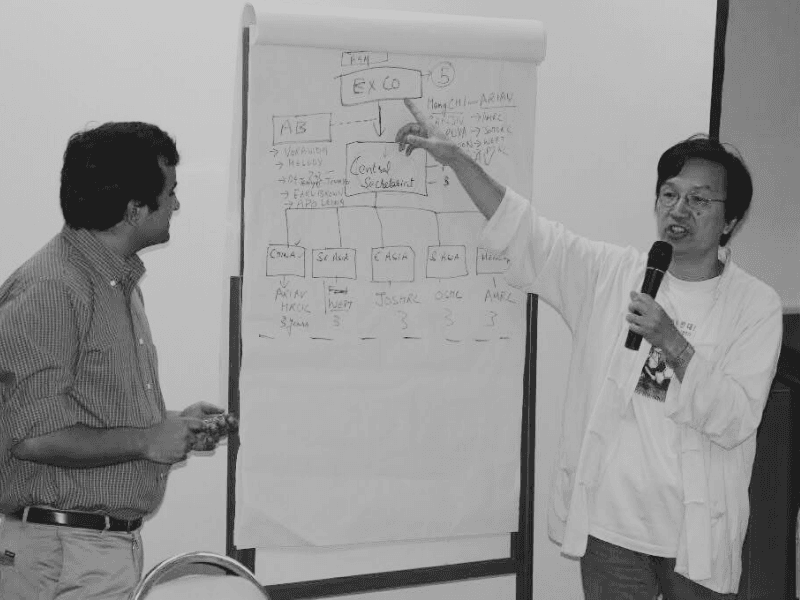
This article draws on a Feminist Participatory Action Research (FPAR) project, “Women’s Labour Rights in the Context of Digitalisation” (2023–2025), organised by the Asia Pacific Forum on Women, Law and Development (APWLD). In this initiative, the Just Economy and Labor Institute (JELI) collaborated with Thai women rider researchers.
Rather than treating workers as passive subjects of exploitation, FPAR positions platform workers—specifically women riders—as co-researchers and primary political actors. The central finding of our collaborative research is that FPAR strengthens the creation of a feminist ecosystem for platform activism by treating the woman worker as a “whole person,” refusing the artificial separation of production and social reproduction. By drawing on workers’ networks of solidarity and their collective emotional intelligence, women riders shift the terrain of struggle from the narrow point of production to a holistic ecology of resistance.
Desire for Freedom and the Cruel Optimism of Gig Work
Empirical data from field research in Thailand (2023–2025) demonstrate the severity of the social reproductive crisis. Riders who earned an average of 700 to 1,000 Baht per day during the pandemic saw their daily earnings slashed by over 50 percent, dropping to a precarious 300 to 400 Baht despite working longer hours. In Southern provinces like Krabi, Trang, and Phang Nga, a survey of 700 women riders revealed that 98% reported their earnings were insufficient to cover basic daily living expenses.
When a worker is classified as an “independent partner,” they lose access to state-mandated social safety nets—such as accident insurance, healthcare, and pension schemes under Thailand’s Labour Protection Act. Algorithmic management systems—including dynamic pricing models, rating penalties, and deactivation triggers—are explicitly engineered to compel riders to work at breakneck paces, routinely ignoring safety protocols and bodily needs. Crucially, the conditions that push workers to self-organise stem from the platforms’ own operational requisites, which demand labour far beyond the limits of physical and social survival.
To understand how workers survive this extraction, we can look through the lens of cruel optimism1 (Berlant 2011)—a condition that occurs when something we desire actually becomes an obstacle to our own flourishing. As riders from a Southern Province recall, the initial days felt like freedom: earning 700–1,000 Baht a day while driving leisurely and taking in the roadside views. However, as platforms systematically adjusted their parameters, this optimism turned cruel.
The platform economy hooks workers using the fantasy of entrepreneurial autonomy, flexibility, and “independent partnership.” In reality, it forces a “slow death”—the physical and psychological wear and tear of a population under late capitalism. The algorithm also functions as an anti-organising architecture, using gamified incentive structures, competitive mechanics, and surge pricing tied to personal acceptance rates to weaponize individual survival against collective solidarity.
Emotions as a Form of Collective Intelligence
Under traditional models, emotions are dismissed as interior, irrational, or counter-productive to hard-nosed labour organising. FPAR, however, approaches emotion as a form of collective intelligence. When women riders gather, their shared anxieties, frustrations, and grief are treated not as private liabilities, but as structural data.
As one single mother balancing a two-year-old child with fluctuating orders noted:
“Exchanging life problems with fellow riders was like releasing the suffering in my heart… it made me feel warm and no longer lonely.”
This affective alignment is the prerequisite for structural resistance; it turns atomized despair into shared analytical power. In a sense, FPAR transforms what Berlant calls an “intimate public sphere”—a space where a collective of strangers share common feelings toward specific issues—into an explicitly political sphere. Research becomes a venue where women workers realize that their personal structural distress is actually a widely shared, systemic condition. By organizing monthly focus groups across provinces, FPAR created an intimate sphere for over 230 female and 50 LGBTQ+ riders in Thailand.
A critical impediment to building a cohesive platform labour movement is that existing rider organisations are deeply fractured by divergent organizational structures, funding mechanisms, and ideological alignments. Our previous analysis of the Thai platform movement reveals that traditional organising approaches generally fall into institutional containment, with each model fragmenting the worker’s lived experience.
Traditional organisational models often compartmentalise workers into distinct identities. For instance, the Health and Safety Model addresses physical medical emergencies and accidents in isolation, treating injuries as individual matters rather than systemic outcomes of employment relations. The Legalistic Model focuses on technical contract violations and statutory definitions, thereby shifting the arena to bureaucratic courts and distancing campaigns from the workers’ community. Finally, the Productivist Model emphasises purely economic grievances, thus disconnecting workers from the domestic and psychological realities of daily survival.
The coexistence of these competing approaches dilutes collective momentum and divides workers into siloed identities. It is precisely against this fragmentation that FPAR intervenes. FPAR honours the whole person, understanding that a rider cannot fight for better working conditions if her child lacks care, or if her body is breaking down from neglect.
Overcoming the Productivist Bias of Power Analyses
The oft-cited Power Resources Approach (PRA) categorizes power into structural (economic position), associational (collective organization), institutional (legal recognition), and societal (public alliances) power. When applied to platform labour in Southeast Asia, the PRA reveals significant power deficits across all categories, heavily constrained by the legal misclassification of workers as independent contractors. This is highly evident in Thailand, where the Ministry of Labour’s proposed Draft Independent Workers Act attempts to institutionalize the exclusion of platform workers from minimum wage protections and social security.
While recent extensions of the PRA observe that platform workers build power through hybrid, community-based forms, the framework’s foundational category—structural power—remains stubbornly anchored to production relations. The PRA treats wage labour and the immediate employment relations as the primary origin points of social power. Consequently, mutual aid networks, emotional care, and socio-cultural safety nets are rendered legible only as supplementary resources, rather than the generative foundation of struggle itself.
Grounded in feminist methodology, the FPAR framework recognizes that labour power is produced and sustained outside the official economy through care, mutual aid, and life-making. Moreover, FPAR democratizes knowledge production, allowing workers to analyze their own lives as a unified whole. It demonstrates that production and social reproduction are not separate spheres, but an inseparable circuit.
By centering the emotional toll of algorithmic control, FPAR expands our understanding of what constitutes “structural power.” The baseline of political capability is affective; if workers are completely depleted by the anxiety of sudden deactivations—where a minor customer complaint can suspend a rider’s account for days without appeal—they cannot build associational power. By treating mutual trust and social relations as foundational elements, the collective reproduction of life becomes the primary political terrain. Informal neighborhood gatherings, relational check-ins, and mutual aid funds are not structural supplements—they are the core of the movement itself.
Turning Affective Infrastructures into Collective Power
Through FPAR processes of collective inquiry, reflection, and action, workers transform everyday survival strategies into sustainable infrastructures of care. A prime example is the emergence of the grassroots “Friends Don’t Leave Each Other” fund, established by female rider leaders in Thailand’s Saraburi province.
Born out of a severe crisis of social reproduction—where platforms offered zero compensation for accidents or fatalities—the fund was catalysed by acute collective trauma: the tragic deaths of two local riders, one of whom was a father of three while the other a single mom. Instead of treating an accident as an isolated occupational issue (as popularised by standard health campaigns), the fund addresses the crisis through a whole-person lens, ensuring that the rider’s household survives while she recovers. This material care infrastructure grew rapidly, attracting 60 members within its first two months.
These physical networks are structurally entangled with digital organizing spaces. Provincial LINE and Facebook groups function as horizontal organizing tools where riders share experiences, validate collective analyses, and provide mutual protection. Riders use these spaces to warn each other of hazardous route conditions, coordinate care-sharing, and manage the fallout of sudden account deactivations.
Grief for the deceased riders did not result in political paralysis; instead, it was metabolized into an infrastructure of survival. When another 18-year-old rider collided with a ten-wheeled truck, the platform company offered total silence and no assistance to the rider after the accident. It was the Southern Riders Association (SRA) and her peers who pooled funds to secure her recovery. By prioritising the material conditions of collective survival, this care infrastructure builds the sustained trust required to launch broader political claims.
The Gendering of Emotional Labour in Self-Organisation
An FPAR lens brings into sharp focus the highly gendered dimensions of social reproduction, illuminating the indispensable role of women in constructing collective care infrastructures. Women riders frequently serve as “network anchors,” performing emotional labour: the unpaid, invisible emotional, cognitive, and organizational work required to keep a decentralized network from breaking down.
This emotional labour operates across a triple burden: delivery work, domestic care labour, and community-building labour. Women bear the primary responsibility for managing households, cooking, and raising children under extreme financial constraints; notably, 95% of the FPAR study group have children. Yet, they simultaneously sustain these vital mutual-aid systems. Furthermore, this gendering manifests in heightened exposure to workplace harm: the FPAR survey revealed that 50% of female riders experienced sexual harassment from customers, yet 73% noted that the platform had zero policies or infrastructure to support victims of customer-perpetrated violence.
Platform algorithms explicitly exploit the forced separation of production and reproduction processes. The algorithm operates on an economistic logic that treats caregiving responsibilities as an individual burden. When a female rider goes offline to collect a child from school or cope with health shocks, the platform’s scoring system triggers automatic penalties—reducing her acceptance rates, blocking her access to high-paying shifts, or flagging her account for deactivation.
By reframing care not as a personal liability but as a collective right, FPAR projects allow women riders to challenge the platform’s anti-care logic. Women leaders systematically prioritize relational maintenance over top-down commands, recognizing that a movement’s sustainability depends on distributing leadership across a broad base. When women riders coordinate care-sharing protocols to cover each other’s offline periods, they replace corporate alienation with a feminist protocol of relational solidarity that honors the whole person.
Because FPAR refuses to separate production from social reproduction, it allows workers to turn intimate reproductive needs into systemic labour demands. This transition is clearly illustrated by how riders politicize basic biological needs.
For female riders in Bangkok and Chiang Mai, the lack of basic urban infrastructure—such as access to clean public restrooms and rest areas—manifested in high rates of urinary tract infections and physical exhaustion. Through FPAR focus groups, what was once endured as a private, isolated health issue was collectively reanalysed as a structural failure of the platform economy. By articulating demands for physical rest zones and safe urban infrastructure, the workers effectively argued that the platform’s workplace extends across the entire layout of the city. This claim links the welfare of the individual body directly to urban planning and corporate accountability.
Conclusion: From Visceral Harm to Collective Campaigns
The FPAR framework successfully translates these shared, embodied experiences into evidence-based political leverage. Since mid-2025, women rider leaders have organised a sequence of provincial meetings, public forums, and national mobilisations to confront policy actors directly. A movement that began with a localised group of female riders in Krabi province successfully expanded across multiple provinces—including Trang, Phang Nga, Saraburi, Lopburi, Bangkok, and Chiang Mai—with further expansions mapped for Khon Kaen and Chiang Rai.
This growing collaboration culminated in the formal establishment of the Thai Platform Workers Federation, positioning grassroots women leaders at the forefront of national labour law reform. The women-led federation has systematically shifted from a defensive posture, where survival strategies merely kept workers afloat, to proactive political mobilisation. By linking bodily precarity (such as the lack of rest areas) to broader advocacy, workers used their collective emotional intelligence to challenge the state’s legal framework, proving that an ecosystem built on care can mount a formidable challenge to transnational capital.
FPAR provides critical tools to build a resilient feminist ecosystem because it shatters the artificial boundaries erected by digital capital and reinforced by conventional, productivist labour organising models. By treating the woman worker as a whole person—whose domestic burdens, physical health, digital interactions, and economic survival are deeply intertwined—FPAR transforms localised care infrastructures into engines of active political mobilisation.
Ultimately, the collective intelligence of emotional labour proves that survival is not a passive state but a sophisticated repository of resistance. When platforms weaponize algorithms to atomise and exhaust workers, the infrastructure of collective care fights back by making solidarity a material reality. By centring the somatic and social realities of the worker, the Thai platform movement offers a powerful blueprint for the future of labour: a movement in which the fight for dignity does not stop at the point of production, but encompasses the right to live, rest, and care as whole human beings.
- Berlant, Lauren. Cruel Optimism. Duke University Press, 2011. https://doi.org/10.2307/j.ctv1220p4w. ↩︎