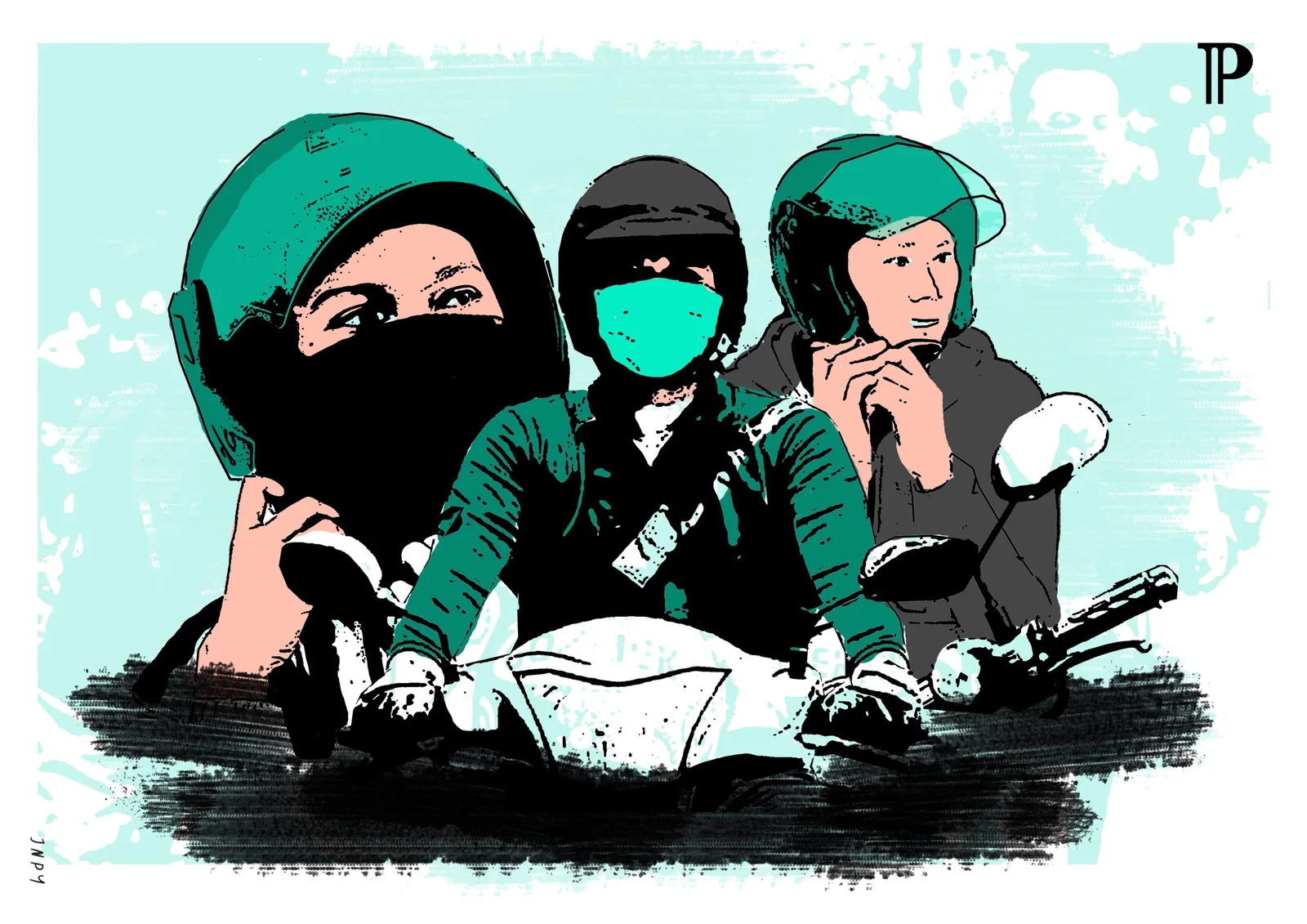
From Uber drivers in the United Kingdom to delivery couriers across Latin America, platform workers have challenged erosion of social protection through legal actions, collective organising, and public protests. For gig workers, benefits such as holiday pay, sick leave, and income stability are reframed as discretionary incentives rather than fundamental and enforceable rights. This is not a side effect but a defining feature of platform capitalism.
A pivotal struggle took place in Indonesia. Ride-hailing drivers demanded the Religious Holiday Allowance (THR), a legally mandated annual bonus equivalent to one full month’s wage for formal workers. When faced with this demand, the government and platform companies introduced the Religious Holiday Bonus (BHR), a non-binding, voluntary, and tiered payment.
The BHR, framed as a ‘voluntary bonus,” institutionalises a parallel, diluted welfare regime that preserves platform control and worker exclusion, normalising precarity through regulatory design. By situating this struggle within global debates on platform misclassification and precarity, it is clear that the fight is not merely for an extra payment but a broader political confrontation over worker classification, state responsibility, and the meaning of enforceable social rights in the platform economy. These struggles reflect a broader transnational contestation of the future of work and social contracts in the digital economy.
The Radical Origin of Religious Holiday Allowances (THR)
In Indonesia, the religious holiday allowance occupies a distinctive place in the country’s labour protection regime. Unlike most countries, where holiday pay is tied primarily to annual leave or collective agreements, the religious holiday allowance is a legally mandated non-wage income paid in cash to workers ahead of major religious holidays.
The religious holiday allowance is culturally and legally significant in the country. It functions not merely as an economic supplement but as a mechanism that recognises religious observance, social reproduction, and workers’ dignity within Indonesia’s plural religious context. It is a social institution tied to religious celebrations, family life, and communal obligations.
Historically, religious holiday allowances were not automatic entitlements. Their origins can be traced back to labour struggles in the early post-independence period, particularly in the 1950s, when workers demanded holiday allowances beyond the civil service. During the 1950s, sustained collective action by trade unions, combined with ongoing political negotiations, gradually transformed the religious holiday allowance from a discretionary benefit into a universal labour norm for formal-sector workers.
By the late 20th century, religious holiday allowances had become deeply institutionalised, operating as a socially expected and legally enforceable right, rather than a managerial privilege. This historical trajectory makes religious holiday allowances a rare example of a culturally grounded labour right that emerged from struggle and was subsequently codified by the state.
The New Legal Architecture of Exclusion
Despite this strong institutionalisation, platform-based ride-hailing and delivery drivers systematically lack access to religious holiday allowance entitlements. Platform companies classify drivers as independent contractors (mitra), asserting that no employment relationship exists between them. This classification has been reinforced by a legalistic interpretation from the Ministry of Manpower, which has maintained for years that religious holiday allowance obligations apply only to workers under formal employment contracts and not to partnership arrangements.
This exclusion is striking. The allowance is not merely a wage component but a social institution tied to religious celebration, family life, and communal obligations—dimensions that platform workers share with formal employees. The absence of comparable holiday allowances for gig workers in most other countries underscores the uniqueness of the Indonesian case: the religious holiday allowance represents a locally rooted form of social protection, whose extension to platform labour raises fundamental questions about employment classification, state responsibility, and the future of labour rights in the digital economy.
This legalistic interpretation has been strongly contested by driver unions. Unions argue that the so-called partnership (kemitraan) model obscures the de facto employment relationship. In practice, drivers perform clearly defined work assigned through digital platforms, comply with algorithmic instructions regarding routes, pricing, and performance targets, and receive income unilaterally determined by the platforms after commission cuts. These conditions fulfil the substantive elements (job, wages, and command) of an employment relationship under Indonesian labour law.
Moreover, the partnership narrative collapses under empirical scrutiny. Platforms unilaterally determine fares, incentive schemes, penalties, and deactivations, whereas drivers have no meaningful bargaining power over the terms and conditions. This asymmetry directly contradicts the premise of an equal partnership implied by Law Number 20 of 2008 on Micro, Small, and Medium Enterprises (MSMEs). Rather than reflecting mutual cooperation, the partnership label operates as a juridical fiction.
Driver Mobilisation (2023–2024)
The organised struggle for a religious holiday allowance among platform drivers gained momentum in 2023, spearheaded by the Indonesian Transport Workers Union (Serikat Pekerja Angkutan Indonesia–SPAI).
It has also been supported by a growing coalition of driver unions and associations, including the Serikat Pengemudi Transportasi Indonesia (Sepeta / Indonesian Transportation Drivers Union), the Serikat Demokrasi Pengemudi Indonesia (SDPI / Indonesian Democratic Drivers Union), the Serikat Pengemudi Angkutan Roda Dua (Serdadu / Two-Wheel Transport Drivers Union), the Serikat Pekerja Pengemudi Daring (SPEED / Online Drivers Workers Union), the Serikat Pengemudi Online Indonesia (SePOI / Indonesian Online Drivers Union), the Serikat Pekerja Bersatu Maluku Nusantara (SPBMN / United Workers Union of Maluku Nusantara), and others.
These organisations articulated a clear and unified demand: the Ministry of Manpower must issue a binding regulation obliging platform companies to pay religious holiday allowances to ride-hailing drivers, online taxi drivers, and couriers. From the outset, unions framed religious holiday allowances as a legally mandated social right rather than a discretionary benefit, emphasising that platform drivers perform continuous and dependent labour essential to urban economies.
Central to this mobilisation was a legal argument based on Indonesian labour law. Unions asserted that drivers fulfilled the substantive elements of an employment relationship, despite being formally labelled as independent contractors. On this basis, unions demanded that religious holiday allowances be paid in accordance with existing regulations: fully, in cash, and without substitution by incentives or discounts.
The Ministry of Manpower initially rejected this claim through a narrowly legalistic interpretation. Citing Ministry Regulation No. 6/2016, senior officials argued that THR obligations apply only to workers under formal employment contracts and not to partnership arrangements. This position effectively treated the legal form of partnership as determinative, regardless of the material conditions under which the drivers worked. Unions condemned this stance as evidence of the state’s failure to protect workers, arguing that it privileged contractual forms over social realities and enabled the systematic denial of labour rights.
Policy ambiguity peaked in March 2024. In a public statement and press conference, the Ministry briefly suggested that platform drivers could fall within the scope of formal employment contracts and therefore be eligible for religious holiday allowances. This announcement was widely interpreted as a breakthrough and was immediately seized upon by unions as validation of their longstanding claims. However, within a day, the Ministry issued a clarification stating that the payment of THR to platform drivers remained merely a recommendation, without sanctions for non-compliance. This abrupt reversal not only neutralised the policy’s practical effect but also intensified workers’ distrust of the state’s regulatory capacity and political will.
The consequences of this regulatory ambivalence were evident in platform practices during religious holidays. Rather than providing a religious holiday allowance as a mandatory non-wage allowance, platform companies offer performance-based incentive schemes tied to working on the first and second days of Eid al-Fitr (Lebaran). Unions strongly criticised these schemes as coercive, arguing that they compelled drivers to work on religious holidays to secure minimal income. Such incentives, they maintained, could not legally or substantively substitute for religious holiday allowances designed to support rest, family life, and religious observance.
By late 2024, the struggle for religious holiday allowances evolved into a broader political confrontation over employment status and state responsibility in the platform economy. Repeated mobilisations, public statements, and coordinated union demands underscored that the issue at stake was not merely holiday pay, but the recognition of platform drivers as workers entitled to social protection.
The unresolved tensions of 2023–2024 laid the groundwork for the escalating protests and partial policy concessions that emerged in 2025, demonstrating both the limits of voluntary regulation and the growing organizational capacity of platform workers in Indonesia.
From Mandatory Rights (THR) to Voluntary Bonuses (BHR)
The struggle for religious holiday allowances among Indonesia’s platform drivers entered a new phase in early 2025, following sustained collective mobilisation led by the Indonesian Transport Workers Union (SPAI) and allied driver organisations. Mass demonstrations in February 2025 forced the Ministry of Manpower to publicly acknowledge the legitimacy of drivers’ demands and the cultural significance of holiday allowances. This marked an important political shift after years of regulatory denial.
The turning point occurred on March 10, 2025, when President Prabowo publicly urged platform companies to provide holiday bonuses, instead of mandatory allowances, to ride-hailing drivers. The following day, the Ministry of Manpower issued a circular formalising this appeal through the introduction of a voluntary religious holiday bonus (BHR), not mandatory religious holiday allowances (THR). The circular prescribed a formula whereby drivers would be entitled to a bonus equivalent to 20% of their average net monthly income over the previous 12 months, subject to performance and productivity criteria. However, this policy intervention explicitly avoided altering drivers’ legal status or establishing BHR as a statutory right comparable to THR.
In response, platform companies have implemented BHR through internal performance-based categorisation systems. For instance, Gojek introduced a five-tier scheme that differentiated drivers based on metrics such as minimum active days, online hours, acceptance rates, and trip completion rates across varying assessment periods. While this framework was presented as a meritocratic distribution mechanism, in practice, it transformed what unions had demanded as a universal social entitlement into a highly selective and competitive reward structure. The highest bonus (IDR 900,000) required a full year of meeting strict metrics (e.g., 25 active days, 200 online hours, 90% acceptance/completion rate), while the lowest (IDR 50,000) was based on one month’s performance. This stratification heavily rewarded an elite minority, while most drivers received a minimal, symbolic payment.
Field-based evidence collected by the SPAI and allied organisations demonstrates the exclusionary effects of this approach. Complaint data indicate that approximately 80 percent of drivers who reported receiving BHR obtained only the lowest-tier amount of IDR 50,000, regardless of their annual earnings or length of service on the platform. IDR 50,000 represents less than one percent of the 2025 Jakarta minimum wage, which stood at IDR 5,396,761. In proportional terms, this amount equals approximately 0.93 percent of the monthly minimum wage, highlighting the stark inadequacy of BHR as a mechanism of income support during religious holidays. By comparison, if this benefit were structured as THR, its value would amount to one full month of wages—equivalent to the minimum wage itself, or IDR 5,396,761.
This finding underscores a sharp disconnect between the policy’s stated formula and its actual distributional outcomes. Rather than approximating 20 percent of the average monthly income, BHR functioned as a flat, symbolic payment for the vast majority of drivers. The absence of enforcement mechanisms within the ministerial circular proved decisive in shaping these results. Because BHR was framed as a recommendation rather than a binding obligation, the state possessed no legal instruments to compel compliance or to penalise underpayment. Distributive authority effectively reverted to the platforms’ internal algorithms and business rules, allowing companies to determine eligibility, bonus amounts, and exclusions without transparency or accountability.
Precarity by Design
In March 2026, the Ministry of Manpower issued Circular Letter No. M/4/HK.04.00/III/2026 concerning the provision of Religious Holiday Bonus (BHR) for app-based drivers and couriers. The circular urges platform companies to provide BHR in cash at a minimum of 25% of drivers’ average net income over the previous 12 months, with payment to be made no later than seven days before Eid al-Fitr.
While the percentage increased from 20% in 2025 to 25% in 2026, framing this shift as a reform would be misleading. Substantively and institutionally, the 2026 circular represents not a correction of precarity but its consolidation. First, the instrument remains a circular letter —a non-binding circular grounded in an appeal rather than an obligation. It calls upon governors to encourage compliance and local labour offices to monitor implementation, yet provides no sanctions for non-compliance. By choosing moral suasion over enforceable regulations, the state reaffirms the contractor paradigm. The absence of coercive authority is not incidental; it is a constitutive regulatory strategy that preserves platform flexibility while externalising risk to workers.
Second, even at 25 percent, BHR remains structurally inferior to THR. Under Indonesian labour law, THR is equivalent to one full month’s wage and is legally enforceable for employees. In contrast, BHR amounts to only one-quarter of the average monthly income and is framed as a bonus compatible with partnership status. The circular reinforces misclassification by offering limited recognition without altering legal status. Instead of extending labour rights, it institutionalises a parallel and diluted regime of social protection for platform workers.
More tellingly, platform implementation diverged from the circular’s income-based formulas. In practice, Gojek distributed BHR through a tiered levelling system with fixed nominal payments ranging from IDR 150,000 to IDR 900,000, depending on performance metrics and repeated level attainment. This scheme departs from the 25 percent formula in three crucial ways:
- Replacement of income-based calculations with tiered rewards
- Performance conditionality through algorithmic metrics
- Selective access marginalises lower-performing drivers, regardless of their annual earnings.
Thus, a measure ostensibly grounded in income protection is absorbed into gamified labour control. Algorithmic governance restructures quasi-social entitlements into competitive incentive mechanisms. The effect is stratification rather than redistribution. Therefore, the 2026 circular should be understood as a continuation of precarization by regulatory design. The state symbolically acknowledges drivers’ vulnerability while preserving their exclusion from enforceable work rights. Platforms publicly comply while filtering benefits through performance hierarchies. Workers receive fragmented and conditional payments instead of universal protections.
Rather than narrowing the gap between BHR and THR, the 2026 framework normalizes a two-tiered welfare regime: one based on rights for formally recognized employees, and another based on discretionary bonuses for misclassified “partners.” In this configuration, precarity is stabilised through law, policy forms, and algorithmic management.
Global Labour Politics
The THR–BHR saga illuminates the broader dynamics of platform labour under neoliberal governance. Under public pressure, platforms often concede limited benefits while preserving their contractor status and algorithmic control. The promise of flexibility in gig work often masks a deeper commodification of labour. Platform systems are also designed to secure corporate immunity and control by ranking and filtering workers through performance metrics, producing an “order of worth” in which only high-performing drivers are selectively recognised, while others remain excluded.
Meanwhile, the Indonesian case demonstrates the continued relevance of collective action. Protests in early 2025 forced government officials and platform companies to respond, demonstrating that gig workers are not entirely outside of regulation or political agency. However, the limited outcome also reveals the constraints of such mobilisation. With an oversupply of labour and weak bargaining power, drivers were able to demand symbolic concessions, such as BHR, but lacked the leverage to secure more fundamental changes, such as employment recognition or standardised protections. In practice, the flexibility often celebrated in gig work tends to deepen precarity rather than reduce it.
These developments must be situated within the broader political economy of Indonesia. Neoliberal restructuring has continually produced large pools of vulnerable labour, allowing platform companies to recruit from an oversupplied workforce and sustain hypercompetition. In this context, digital capitalism has been associated with forms of structural super-exploitation supported by labour abundance, intense platform rivalry, and permissive regulatory environments. The government’s reliance on non-binding policy instruments rather than enforceable regulations reflects a longer trajectory in which labour reforms have tended to favour capital accumulation over worker protection.
Publicly, BHR is framed as evidence of growing concern for gig worker welfare. However, materially, it falls far short of meaningful social protection. This discrepancy reveals BHR as largely symbolic, allowing the state and platform companies to project an image of care while avoiding substantive economic and legal obligations. More broadly, partial and discretionary concessions can function as pressure valves that defuse collective resistance while preserving structural inequalities. By presenting festive bonuses as recognition, platforms include workers without altering the underlying denial of employment status. Such gestures operate within the moral economy of platform capitalism, where symbolic care coexists with persistent insecurity and labour commodification. Without legal enforcement and standardised entitlements, initiatives such as BHR risk becoming empty signifiers of concern rather than genuine mechanisms of protection.
The core political struggle transcends singular benefits, such as a holiday allowance, and centres on a fundamental dilemma: will platform drivers gain recognition as workers with full rights, or will they continue to be trapped in the precarious digital gig economy? At stake is the much broader question of who should bear the responsibility for social reproduction—the platform companies, the state, or the workers themselves. The union campaign has evolved into a touchstone of resistance, a symbol of emerging solidarity across gig economies, and a reminder that platform labor conflicts are rapidly becoming central battlegrounds of contemporary neoliberal capitalism.
A version of this article in Bahasa Indonesia has appeared in IndoProgress.